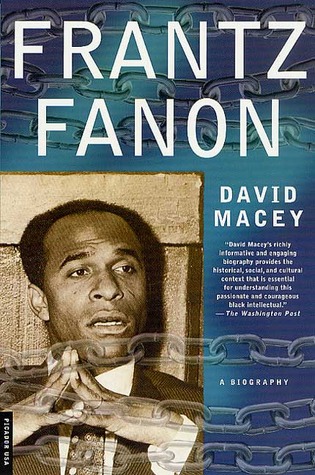
This is certainly among the best biographies I have encountered. The subject, Frantz Fanon, was complex and challenging and he is not presented as an icon, but rather as an individual. This seemingly bland remark is worth unpacking. If Fanon is to be set up on a plinth as a model or as a paragon, then the flaws - both personal and theoretical – identified in this biography will topple any statues. Fortunately, the reality is far more impressive than the myths, of which Macey identifies and demolishes a large number.
Macey provides a very detailed, chronological account of Fanon’s life story: his childhood in the French colony of Martinique, his service in World War 2 as a French soldier, his training and professional practice in psychiatry, his engagement with the Algerian war of independence against the French, his contributions to Black African literature and culture, his political writings and his untimely death from Leukaemia at the age of only 36 years. It was a very full and eventful life and the story is told with style and a deep commitment to the truth.
A critical point emerging from this is that Fanon’s activities and writing were very much a product of his situation and his own lived experiences. For example, his work as a psychiatrist, in Algeria and Tunisia, was often experimental and innovative, and typically demanded energetic confrontation with outdated practices, but it was built on the foundations of his training and early experiences in France, was entirely in line with contemporary developments in the field of psychiatry in other countries, and was performed in collaboration with others of his profession.
Wrapped around this, a huge amount of wider history is described, most importantly a history of the Algerian War; reference to other liberation struggles (the Congo is one example) is patchy though interesting. The early history of France’s unprovoked invasion and colonisation from the 1830s onwards comes surprisingly late in the book, to be honest, it would have been helpful to unpick a little more detail when he observes that the French did seriously and explicitly consider emulating the USA’s genocide of Native Americans when they drove native Algerians from their lands and property and the book does not really engage sufficiently with the importance of Islam as a factor in the struggle for independence, despite a few useful asides, such as a discussion of the role of women. After all, the saga of French engagement with North African Islam is by no means resolved today, and even President Macron has been known to appeal without embarrassment to France’s “civilizing mission.”
Fanon’s writings are described at some length and subjected to very sharp scrutiny. Despite their huge impact, Macey is not overawed. He finds them poorly researched, factually unreliable, making unjustifiable generalisations from special cases, inconsistent and weakly argued. He points out that Fanon makes predictions that have demonstrably failed and often misunderstands what he has observed. He attributes these failings to the very constrained conditions in which they were written, which is especially so in the case of his most famous work, The Wretched of the Earth, written in a few short months while Fanon was dying of leukaemia. On the other hand, he is highly critical – even snortingly dismissive – of the way Fanon has been poorly translated into English, his writing often taken out of context, subject to selective reading as well as direct misrepresentation, and distorted in order to support other agendas. Macey argues that Fanon himself is sometimes idealized and his contributions exaggerated in ways that are just not supported by evidence.
What emerges from this critical biography is a more truthful, more three dimensional and in many ways far more admirable Frantz Fanon, generous, humane and incredibly energetic, willing to make commitments and willing to risk being wrong, who achieved a great deal in his short life and bequeathed a lasting legacy in his ideas and his values.
Quotes that follow are from the digital edition, whose page numbers differ a lot from the hard copy which I initially used.
One of the striking features of many of the tributes to Fanon that were published immediately after his death is the stress placed on his fundamental humanism. The negative emphasis on the theme of violence is probably a reflection of the American reception and of the way in which Fanon is read by Hannah Arendt in her book On Violence. She looks at Fanon’s influence on the violence that afflicted American university campuses in the 1960s, but fails to make any mention of Algeria[p51]
Outside France, the most familiar image of Fanon was for a long time that created in the United States, where Grove Press advertised Constance Farrington’s flawed translation of Les Damnés de la terre as ‘The handbook for a Negro Revolution that is changing the shape of the white world.’[p52]
... the self-identification of civil rights workers, black power activists and Québecois separatists with Fanon’s wretched of the earth necessarily involves the misrecognition of exaggeration. In the United States, civil rights workers did encounter terrible violence and the protests of the Black Panthers did meet with armed repression. But they were not faced with General Jacques Massu’s Tenth Parachute Division and the mercenaries of the Foreign Legion. When Fanon speaks of ‘violence’, he is speaking of the French army’s destruction of whole villages and of the FLN’s bombing of cafés, or in other words of total war and not of limited low-level conflict. The extreme violence of the Algerian war was, fortunately, not reproduced in the United States or Canada. [p54]
The new interest in Fanon’s first book is a product of the emergence of post-colonial studies as a distinct, if at times alarmingly ill-defined, discipline. [p55] ... Fanon is one of the very few non-Anglophones to be admitted to the post-colonial canon, and alarmingly few of the theorists involved realize – or admit – that they read him in very poor translations. The most obvious example of the problems posed by the translations is the title of the fifth chapter of Peau noire, masques blancs. Fanon’s ‘L’Expérience vécue de l’homme noir’ (‘The Lived Experience of the Black Man’) becomes ‘The Fact of Blackness’. The mistranslation obliterates Fanon’s philosophical frame of reference, ... that experience is defined in situational terms and not by some trans-historical ‘fact’.[p56]
The ‘post-colonial Fanon’ is in many ways an inverted image of the ‘revolutionary Fanon’ of the 1960s. Third Worldist readings largely ignored the Fanon of Peau noire, masques blancs; post-colonial readings concentrate almost exclusively on that text ... The Third Worldist Fanon was an apocalyptic creature; the post-colonial Fanon worries about identity politics, and often about his own sexual identity, but he is no longer angry. His anger was a response to his experience of a black man in a world defined as white, but not to the ‘fact’ of his blackness. It was a response to the condition and situation of those he called the wretched of the earth. The wretched of the earth are still there, but not in the seminar rooms where the talk is of post-colonial theory. They came out on to the streets of Algiers in 1988, and the Algerian army shot them dead.[p58]
Recognizing that Fanon could be – and often was – wrong is part of what Henry Louis Gates Jr. has called ‘the challenge of rehistoricizing Fanon’.[p59]
The classics of French phenomenology – Merleau-Ponty’s Phénoménologie de la perception and Sartre’s L’Etre et le néant – are obviously not treatises on racism and anti-racism, but they provided tools that were much better suited to the analysis of ‘the lived experience of the black man’ than either Marxism or psychoanalysis.[p178]
Nothing could prepare him for the most devastating experience of all. It occurred on a cold day in Lyon when Fanon encountered a child and his mother. This is possibly the most famous passage in Peau noire, masques blancs. The child said to his mother: ‘Look, a negro’ and then ‘Mum, look at the negro. I’m frightened! Frightened! Frightened!’[p164]
The being-in-the-world that he had established for himself collapses into a being-for-others. Under the gaze of the child and its mother, Fanon now becomes ‘responsible for my body, responsible for my race, for my ancestors. I cast an objective gaze at myself, discovered my blackness, my ethnic characteristics – and my eardrums were bursting with cannibalism, mental retardation, fetishism, racial taints, slave-traders and above all, above all, “Y a bon banania”.’ He feels nauseous. Nausea is, in Sartrean terms, an expression of shame: ‘Being ashamed of onself is a recognition that I am indeed the object the other is looking at. I can only be ashamed of my freedom to the extent that it escapes me in order to become a given object.[p226]
The final pages of Peau noire, entitled ‘By Way of Conclusion’, are a hymn to freedom in which Fanon rejects in very Sartrean terms all determinism and insists that his freedom is both absolute and self-founding to the extent that it transcends history. ‘Superiority? Inferiority? Why not quite simply try to touch the other, feel the other, reveal the other to me? Wasn’t my freedom given to me to build the world of the You?’ [p248]
The third edition of Antoine Porot’s dictionary of psychiatry, published by France’s leading academic publishing house in 1975, still contained entries by Henri Aubin on ‘North African Natives (psychopathology of)’, ‘Blacks (psychopathology of)’ and ‘Primitivism’. The former begins: ‘The primitive mentality must be evoked here, particularly as we are speaking of a less highly evolved ethnic group . . .’ It need scarcely be added that the same dictionary contains no entry on ‘White Europeans (psychopathology of)’. No one attempted to explain the massacres at Sétif and Kherrata in terms of the innate psychological traits of white settlers. [p297]
Fanon’s explanation of what was going on in Algeria is harsh and couched in staccato phrases in which one can both hear the voice of the man who could declaim passages from Césaire’s Cahier to such effect and that of the author of Peau noire: ‘I want my voice to be brutal, I do not want it to be beautiful, I do not want it to be pure. I want it to be completely strangled. I do not want my voice to enjoy this, for I am speaking of man and his rejection, of the day to day putrefaction of man, and of his appalling abdication.’ [p354]
...most fighters were illiterate and the wilaya produced their own propaganda material. Inside Algeria itself, radio was a much more effective propaganda medium than the written word. After 130 years of the French civilizing mission, the illiteracy rate was astonishingly high: in 1954, 86 per cent of Algerian men and 95 per cent of Algerian women could not read.[p421]... Colonization did not lay the foundations of Western society in Algeria. It created a divided and unevenly developed society, segregated along ethnic lines. ... As in Martinique (albeit it on a very different scale), Algeria’s ‘development’ was actually an underdevelopment. It could not be permitted to compete with France [p604]
Fanon had already rejected negritude as a ‘great black mirage’ in his 1955 article on ‘West Indians and Africans’, ... In Les Damnés de la terre, he returned to that topic in more detail. He now argued that the doubts about the existence of a universal black culture expressed by Richard Wright and others in Paris demonstrated that cultures always existed in national contexts, and that the problems faced by Wright or Langston Hughes were therefore not the same as those facing Senghor or Jomo Kenyatta. In the underdeveloped countries, national culture meant the struggle for national liberation, not folklore or an abstract populism. Those who were still fighting in the name of Negro-African culture and organizing conferences dedicated to the unity of that culture should realize that they had all been reduced to comparing coins and sarcophagi. [p476]
Negritude could exist only in the context of white domination: blacks from Chicago and blacks from Nigeria or Tanganyika were the same only to the extent that they defined themselves in relation to whites. It was the dominant white culture that had described all the inhabitants of Africa as ‘negroes’ and the people of Algeria as ‘Arabs’ or ‘natives’. [p477]... Something had begun to change when ‘the negroes’ began to describe themselves as ‘Angolans’ or ‘Ghanaians’; as Amrouche had remarked in 1956, Algeria was beginning to be inhabited by ‘Algerians’ and not stateless ‘natives’. The theorists of negritude had, according to Fanon, failed to register that change. [p478]
Fanon speaks of a ‘nation born of the concerted action of the people’ but does not define that people in either religious or ethnic terms. In his remarkably generous discussion of the role and fate of Algeria’s European minority in L’An V de la révolution algérienne, Fanon is quite explicit about what he understands ‘Algerian’ to mean: any individual living in Algeria was a potential Algerian and could decide to be a citizen of the nation of the future. Fanon’s ‘nation’ is the dynamic creation of the action of the people, and his nationalism is a nationalism of the political will to be Algerian, not of ethnicity. And it is this nationalism of the will that allows him to speak in Sociologie d’une révolution and Les Damnés de la terre of ‘we Algerians’. [p491]... In practice, the Code of Nationality adopted in 1962 defined Algerian nationality in both ethnic and religious terms and made Islam the state religion, though it also specified that citizenship could be granted by decree to non-ethnic and non-Muslim ‘Algerians’. It was granted to only a tiny number of Europeans.[p492]
Fanon’s explosive text is actually made up of material dictated to his wife in the spring and summer of 1961, and supplemented by previously published and reworked material. The ‘Bible of Third Worldism’ was composed ‘in pitiful haste’ by a man who was dying but still trying to live up to the demands of a revolution.[p569]... Between April and the beginning of July, Fanon worked fast against the clock. The final text reflects the speed at which he worked. Little or no research was done. His impressions of what he had seen of the newly independent states of Africa merge into a nightmarish picture of colonial Algeria. Fanon’s hopes and fears for the future are expressed with powerful emotion, but he rarely justifies them with hard facts.[p570... The composite image of the ‘Third World’ that emerges from the book is in part a product of Fanon’s relatively limited experience, of the circumstances in which it was composed and of Fanon’s style of working. There is no indication of extensive or original research on his part [p589]
Sartre and Beauvoir got on well with Fanon, who could be seductively charming when he wished to be. To Beauvoir’s surprise, he proved to have a personal horror of violence. Although he justified the use of violence both on the public platform and in print, he was obviously deeply distressed when he spoke of the violence inflicted by the Belgians in the Congo and the Portuguese in Angola. More surprisingly, he displayed the same emotion when he spoke of the ‘counter-violence’ of the colonized and of the settling of scores that had taken place within the FLN... He thought, however, that his personal dislike of violence was a failing that reflected his position as ‘an intellectual’. [p578]
Fanon and violence’ is now such a spontaneous association in France that it trivializes what he is actually describing. [p594]... What, in reality, is this violence? . . . It is the colonized masses’ intuition that their liberation must come about, and can only come about, through force.’ In a sense, it is the term ‘violence’ itself that is so scandalous; had Fanon spoken of ‘armed struggle’, the book would have been much less contentious.[p595]... Critics like Daniel and Domenach suggest that Fanon’s theses on violence are an attempt to justify the unjustifiable. Hannah Arendt makes the same point and quite erroneously claims that he glorifies ‘violence for its own sake’. Fanon does not ‘glorify’ violence and in fact rarely describes it in any detail: there are no descriptions of what happens when a bomb explodes in a crowded café and when shards of glass slice into human flesh. The violence Fanon evokes is instrumental and he never dwells or gloats on its effects. In a sense, it is almost absurd to criticize Fanon for his advocacy of violence. He did not need to advocate it. The ALN was fighting a war and armies are not normally called upon to justify their violence.[p595]... Nkrumah’s ‘positive action’ may not have appealed to him in either ideological or personal terms, but Fanon was well aware that Ghana had been decolonized without an armed struggle. He even suggests that France’s military involvement in Algeria meant that it could not fight colonial wars elsewhere and that peaceful decolonization was possible in West Africa. Fanon’s violence is primarily the violence of Algeria and its history. When he insists that a violent liberation struggle leads to a higher or purer form of independence, he is thinking of the future independence of Algeria. What he fails to recognize is that, in terms of the decolonization of ‘French’ Africa at least, Algeria was the exception and not the rule.[p596]
As Aimé Césaire remarked when he parted company with the PCF in 1956, it was obvious that ‘the struggle of colonial peoples against colonialism, the struggle of people of colour against racism is much more complex – what am I saying? – of a completely different nature to the French worker’s struggle against French capitalism and can in no way be regarded as a part or fragment of that struggle.’ By 1961, there can have been few issues over which Fanon and Césaire were in agreement, but this was one of them.[p600]
It is, however, impossible to reconcile Fanon’s idealization of the peasantry with the reality of what happened to so many young people who fled into the countryside after the Battle of Algiers. They were killed by Amirouche and his men during the ‘blueitis’ episode. As a black outsider who was both intellectual and urbanized to his fingertips, Fanon himself would not have survived long in Amirouche’s company.[p606]
The fundamental ambiguity of Les Damnés de la terre is that, whilst Fanon constantly prophesies the victory of the people, the theoretical model he adopts necessarily implies that the group unity on which that victory is based cannot be sustained. In a sense, Fanon foresaw that the post-independence period would be difficult and dangerous; he could not foresee that it was a bureaucratized army that would hold the real power in an independent Algeria. And he did not live to see it do so. [p610]